
How Soccer’s Small-Sided Cousin Can Transform Grapevine

3 Jun 2026
News, Blog, 2026
Something big is coming to North Texas this summer. A monumental occurrence in the world of sports, synonymous with international culture and somehow instantly recognizable to any American while striking most of us as foreign. One game, played almost exclusively with your feet, that may be the closest the world comes to a universal language outside of mathematics.
Obviously, we’re talking about futsal.
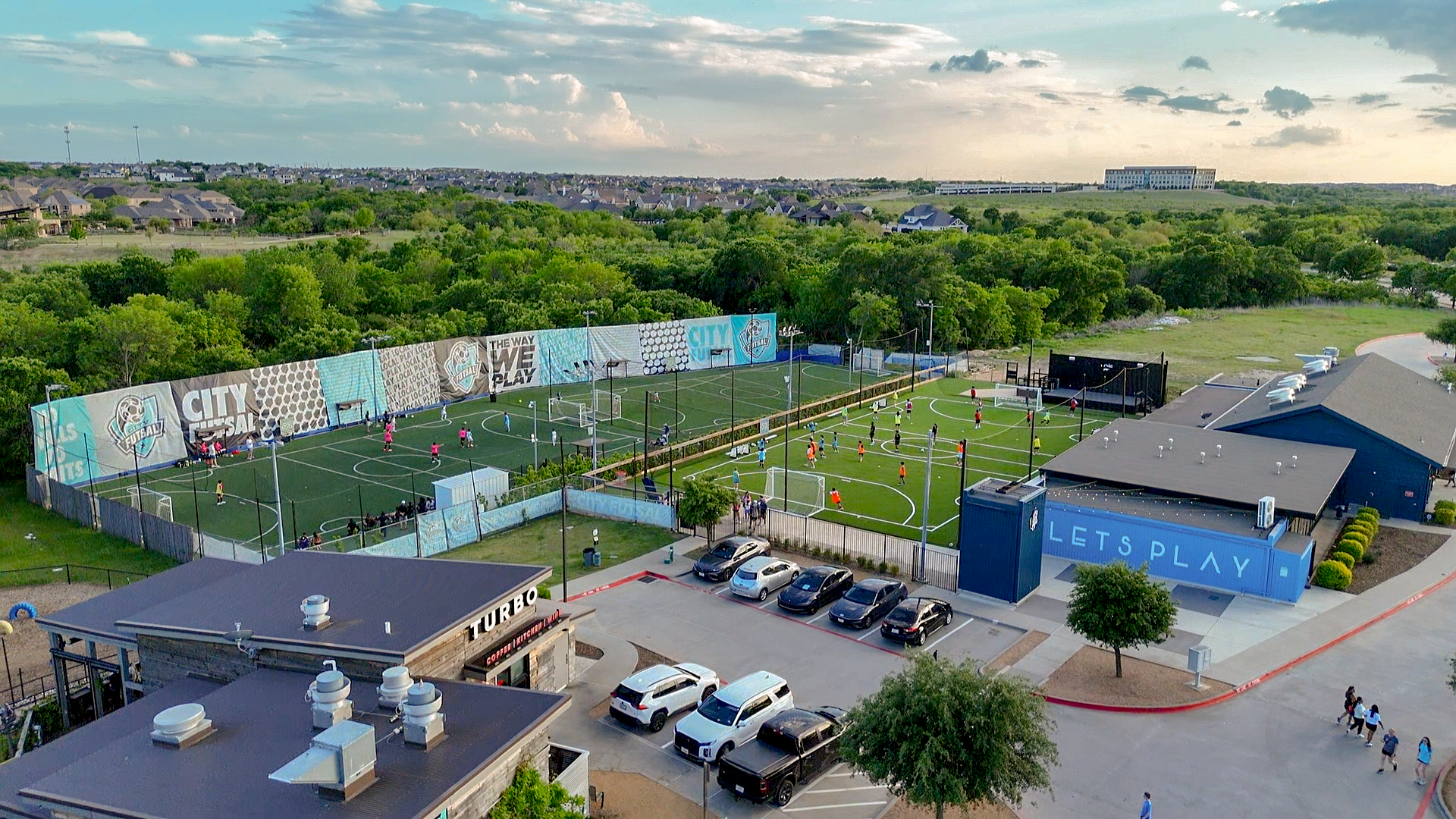
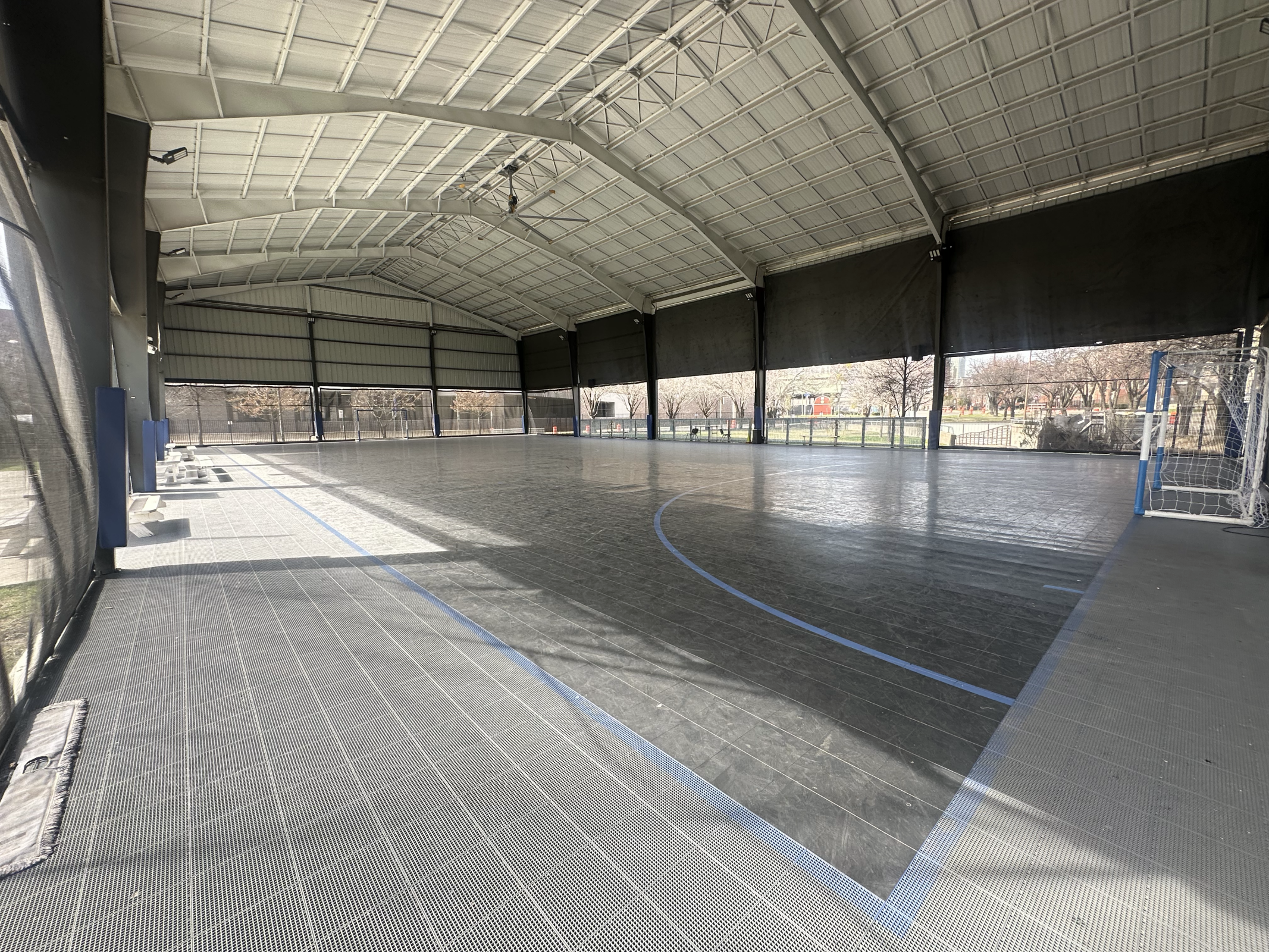
A miniaturized version of soccer that’s usually played 5-on-5 atop turf or a coated hard surface, futsal requires far less space and personnel than the Beautiful Game. Those low barriers to entry – and easily maintained turf or court playing surfaces – help make it more accessible and, therefore, more easily adopted. But the Mariel family didn’t just adopt the game for convenience when they launched City Futsal. They see the game’s fast pace and forced flexibility as ideal tools for developing players who build communities.
“Shipped Off to Brazil”
Manuel and Esteban Mariel have been coaching young soccer players for a long time, but they’ve been playing the game even longer. As twins, they grew up playing together and eventually competed at the collegiate level in Maryland before transferring to Southern Methodist University. These days, they split leadership duties at the family company: Esteban serves as CEO, while Manuel oversees operations. But long before they laced up their boots in Dallas, they had a unique opportunity to hone their skills a little farther South.
“We say we were shipped off, but it wasn’t like our father didn’t want us anymore,” Esteban said. “He gave us an opportunity to experience our mother’s culture; our mother is from Brazil. Soccer is king there, but the most participated sport in Brazil is futsal. Because it’s a small-sided sport... you can see a thousand more scenarios and situations of the game than you would on an outdoor, larger field format.”
“It's technical in the sense that the focus, instead of trapping, gets to be about dribbling and passing and shooting. Because of the small space, you’re really getting to invite the creativity of the player into the game.”
The brothers learned a lot in their limited time on the courts and pitches of Brazil, and the lessons carried far beyond their on-field skillset. When they graduated from SMU and stepped into the job market full time, they had a sturdy foundation on which to build a coaching and player development business. Because they played both soccer and futsal at a high level, they understood the game and the cost of pursuing a career in it on an intimate level. But more than that, they got access to an enviable coaching tree.
“We had a great mentor in Brazil, [Alexandre Barata], who is the Director of Santos Futsal. He would always say you do what you know, and that doesn’t make you right or wrong. Touches are important, but context and situations are even more so. When we say this is a sport of skill, I can’t just dribble around a cone and think I’m learning a skill of the game. A skill has to involve a defender.”
For the Mariel family, futsal was the ideal tool for skills development because the game itself serves as the teacher. It challenges players, forcing them to think fast and hone multiple aspects of their game at the same time. Futsal was, to borrow Barata’s phrase, “what they knew.” And they wanted to pass it on.
Building a Brand… and World-Class Athletes
Private sports coaching is a multi-billion-dollar industry in the United States, in part because the nation’s vast population and cultural affinity for a broad array of sports means nearly unlimited demand for instruction. There are personal trainers, team coaches, and skills instructors at just about every level of every major sport here in America, and no shortage of opinions on how badly they are needed and what they should cost. That’s especially true in soccer, where fans regularly complain about the failure of our men’s national team to compete on the global stage. US Soccer, the nonprofit behind that team and the more successful women’s program, recently launched a developmental overhaul to tackle the issue.
When they set out to found the company that would evolve into City Futsal, Esteban and Manuel saw themselves as part of the solution. Within a few years, however, they were thinking bigger.
“We started off wanting to produce that next player. We can say it wasn’t about ego, but there’s always a little ego in that. You want to be a part of it, right? I’ll go back to Barata, our mentor, who would say ‘Santos Soccer Club did not produce Neymar. The City of Santos produced Neymar.’ That was always in our mind; to want to be a part of that growth and that impact with an individual player who goes on to play at a high level,” Esteban said.
“I think the shift into communities was recognizing and realizing a larger impact of what the sport and the environment can do, for a neighborhood and for a community. That’s progressed over time and that’s where the tides are turning. When we talk about communities and neighborhoods. Belonging. Far too many people are behind a screen and their communities are online... we want to bring a community together to develop, belong, and return. And the best way to do that is to do that in neighborhoods.”
These days, City Futsal is focused on creating space for organic relationships rather than churning out top notch players. Although, to be fair, the Mariel family’s list of previous clients contains more than a few notable professionals: Jaedyn Shaw, a Frisco native with dozens of USWNT caps; Tomas Pondeca, who holds a contract with FC Dallas and is currently on loan in the USL; and Patrick Koffi, a Dallas-area native now playing professionally in France. The brothers are proud of those individual success stories, but they insist the brand has expanded.
“It all goes back to our mission: the development and growth of kids. People. A sense of belonging. Our business is a family-run business. Our younger brother Felipe, our sister Ximena, and our father Federico are all in this business together,” Manuel said.
Those same family members will be overseeing City Futsal’s arrival in Grapevine; a step they see as the next logical move in their quest for slow, specialized growth of the game they love here in the US.
Fans, Futsal, and Collective Culture-Making
Given the breadth of the issue at hand – alongside the growing popularity of soccer and its affiliate sports – it’s no surprise that plenty of passionate people are pitching broad overhauls to US Soccer, youth sports, and this country’s cultural approach to the Beautiful Game. The team at City Futsal sees themselves as part of that equation. But they’re leery of large-scale, top-down approaches to player development and community building. Instead of trying to build one program they can roll out anywhere, the Mariel family tries to understand each of their host communities as a distinct place. Parts of their business model can fit any market, but they’d rather adapt to a City than ask residents to make room for them.
“Everybody wants to change everybody’s life overnight, up top, for all 360 million people in the US. But what it takes is the small steps in each community that will change it. So, for us, our ego was pushed out. Our goal is not to do that today. Our goal for today is to give Grapevine what they need and want,” Manuel said. “You keep taking the small steps, and maybe one day if enough people get behind you and keep coming back, then you absolutely will see transformation.”

It may seem heady to think a three-court futsal facility could create that level of social impact, but the family argues that a shared space is the first step in building the kind of coherent community that can shape a culture. In a world of fractured relationships, strained by online interactions and fractured by a half-decade of institutional instability, they think the first step is to re-instill neighbors with a sense of belonging. This summer’s World Cup festivities will be part of that, and so will the resulting energy that drives people toward a new experience.
City Futsal hopes to give longtime players and curious newcomers a gathering place in the wake of the tournament and beyond. They’ll have varied levels of competition and social areas for chatting after games; in-house programming and strategic partnerships that give community members a broader set of tools for building their own space. Altogether, they’re bought into the importance of a generational rallying cry: sometimes, we all just need to touch grass (or turf, or vinyl, or polypropylene tiles…).
“Culture comes from the fans, a lot of the time,” Esteban said, “The world is interconnected today, and I think people are going to see that with the main event coming this summer. We had the World Cup in 1994, and it was fantastic. But what the sport is today, versus where it was in ‘94? You can’t compare it. The interaction with the sport is much larger today. The youth are all playing it, it’s one of the fastest-growing sports for youth and it’s going to continue in that direction.
“People need to be excited. We need to be open-minded for what’s to come, because the people coming over here – if you get to sit with them, be in the stands with them, or be in the street with them – they will share your same values and goals; so many of the same things as you. You just need to get out there and interact with it. My hope is that it breaks a lot of barriers down... and really just shows the humanity, that football, soccer, the sport, can bring people together. This game is one language, and the way we speak is with our feet.”
If you want to play a role in shaping the culture of Grapevine, be sure to subscribe to the ‘Growing Grapevine’ podcast and eNewsletter. Got a passion project of your own? Let’s talk about it.
More Topics

.jpg)