
Retired Grapevine Restaurateur Bringing Baseball to a Board Near You

1 Feb 2026
News, Blog, 2026
Grapevine is no stranger to America’s Pastime. Between local leagues, tournaments, and a burgeoning collegiate presence, thousands of young players take the mound here every year. You may have also heard that Grapevine’s own Mustangs are back-to-back defending champions in UIL baseball. This is as close to a five-tool baseball town as you can find, with one more feather to put in our rally caps: Homeplate USA.
The brainchild of a current Grapevine resident with a business address in Grapevine, Homeplate is a simple board game with an origin story nearly as unbelievable as Henry Rowengartner’s. It was originally invented on scrap cardboard and kept hidden from prying eyes. Now, it’s poised to hit retail shelves across the metroplex.
But for creator Miguel Otero, fame and fortune were never the goal. He’s in this for the love of the game.
Love at First Bat
Born and raised in Puerto Rico, Otero had a unique relationship to baseball. He knew the game from a distance, re-enacting plays by swinging bare hands at a foil ball and eventually watching other kids play in the street near his house. Their home plate was a manhole cover, conveniently located so that he could watch every at-bat while waiting for a chance to join in.
“They would pick me, every single day, to play the last inning. Never an at bat, always fielding. Which was fine with me, because I had no idea how to bat with a bat. I had always batted with my hand, with an aluminum foil ball. From there, I went to creating my own world,” Otero said.
He used a paper grocery bag, the lid from a discarded shoebox, and his sister’s plastic jack-o-lantern to fashion a field of his own, mixing hand-written tiles into a bucket intended for Halloween candy until he could simulate hits, outs, and exciting plays like the ones playing out near his house. The mechanic was simple: fish around for a chunk of cardboard, read it, and mark the resulting play on a hand-drawn baseball field until nine fictional innings were complete. Early games looked a lot like little league: high-scoring affairs with plenty of hits and runs batted in. But they all played out in secret.
“I think, honestly, it was the first fantasy baseball game ever in the island. I don’t know about here [in the States] – I’m pretty sure it wasn’t here – but in the island, it was the first ever. And something not to be proud of. Something you are shamefully carrying with you, hiding that you have a game you play because you are a loser. And the sad thing is that I created it in order for me to be the star… but it didn’t work that way. I was just another player in my game.”
Making the Numbers Work
Over the years, Otero refined his hobby and his understanding of the sport that inspired it. He ended up playing college ball in the continental United States before launching a career in restaurant management, always dragging along a prototype board game or making a new one when the pieces wore thin. The child of two accountants, he got used to crunching numbers for fun: whenever the family car stopped at a red light, they raced to find the average of digits on the nearest license plate.
A love of numbers is a handy skill in any kind of management, but the trait holds a special place in the hearts of baseball fans because the diamond tends to be dictated by stats and metrics. Few sports have so many data points to track, and none have the legacy this one does in America. In fact, the game’s borderline religious preservation of everything from batting averages to on-field errors helped shape Homeplate USA.
“At the beginning, the scores were very similar to the scores I was seeing on the street. 13-10, you know. So I started modifying, as I grew up, the ratio of how many hits and how many outs. That became the formula, and it was a very simple formula.”
Armed with nearly a century of pro baseball statistics, Otero whittled his game down to the simplest simulation imaginable: 100 tiles, marked with every conceivable event that can happen in a game, and weighted by likelihood before being sorted into a canvas bag for random generation. The overall batting average for Major League Baseball when he last refined the game? .250; worthy of 25 tiles in the batch. Of course, he includes a few extra tiles for folks who’d rather simulate a game with more action by swapping hits in for outs. When we met for our interview, he brought multiple versions of the game, all with hand-written hitting figures on the side as a reminder of the relative difficulty within each box.
A true salesman, Otero knows it’s easier to market a game with Little League box scores than professional ERAs. His business plan is the same as any entry-level coach: focus on the fun.
From Blackout to Rollout

Despite the acumen of its creator, Homeplate USA wasn’t designed for market appeal. In many ways, it was simply Otero’s love letter to the game that defined his childhood. He played it privately, sometimes scrambling to explain it to family who spotted the pieces out of context. His own son had never played it until a storm knocked out the family’s power a few years back, prompting the emergency creation of another game board.
They played together for hours, even after the power came back, such that the game made a lasting impression on the younger Otero.
‘The prototypes started getting better, and every time I made one my son kept it,” said Miguel. “Unbeknownst to me, he was giving them away. Sending them to his friends. That was 2015. As time went on, I started getting feedback that it was like Strat-O-Maticbut better… by the third time I heard that, I said ‘what is Strat-O-Matic?’”
Curious, Otero ordered a copy of the legendary sports game to try it for himself. The rulebook was daunting and, while “the original FANTASY sport game” undeniably captured more details than Homeplate USA, the simple mechanics of the latter made it easier to teach and less daunting on approach. Disappointed that his concept wasn’t original, Otero nonetheless decided to fabricate 100 high-end prototypes.
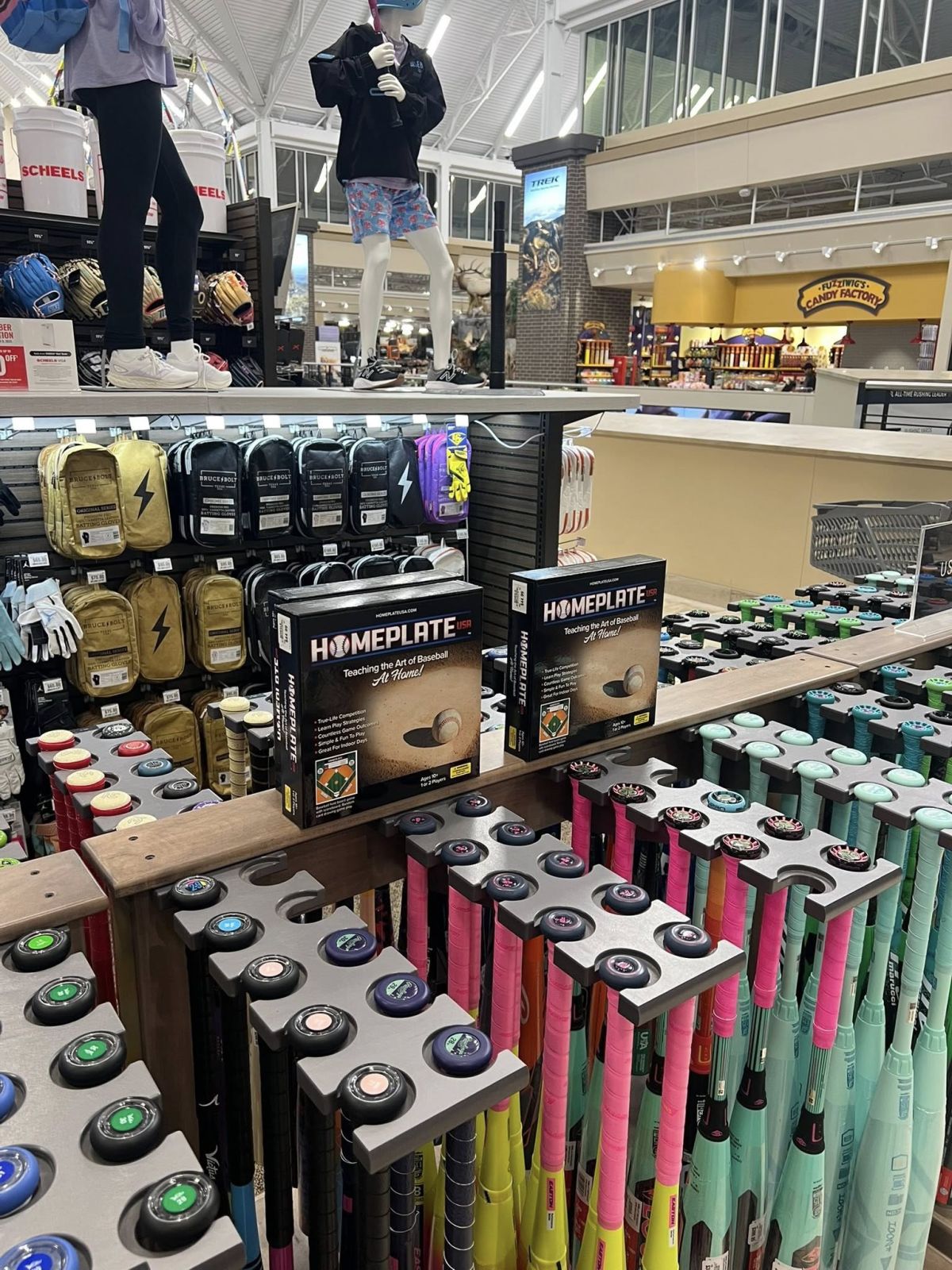
He thought it would be a good hobby in retirement, and planned to give away copies when family or friends had special events. But eventually, the game ended up in a collegiate clubhouse, where coaches with distant ties to the Otero family used it for situational baseball training. Requests for copies trickled in, and the family moved from their original game sharing model to online sales. Now, early editions are available at SCHEELS, with a larger version for kids and players with special needs in development. Otero is also angling for a final version that comes with its own regulation-sized home plate built into the lid, giving customers an essential building block for their own sandlot games.
These days, you’ll catch the team at Miracle League events, gathered under a branded tent and offering families a chance to play the creator for a shot at a free copy of his game. Although, Miguel confesses, its rare for players to leave empty-handed even when they lose. That, too, is a brand strategy: the Otero family frequents baseball fields around DFW, casually inviting fellow enthusiasts to play with them and packing a few extra copies to give away.
It’s not the best sales model, but then again, sales were never really the point.
For more stories about unique individuals and businesses here in Grapevine, be sure to subscribe to the ‘Growing Grapevine’ podcast and eNewsletter. Got a passion project of your own? Let’s talk about where Grapevine fits into your plans.
More Topics